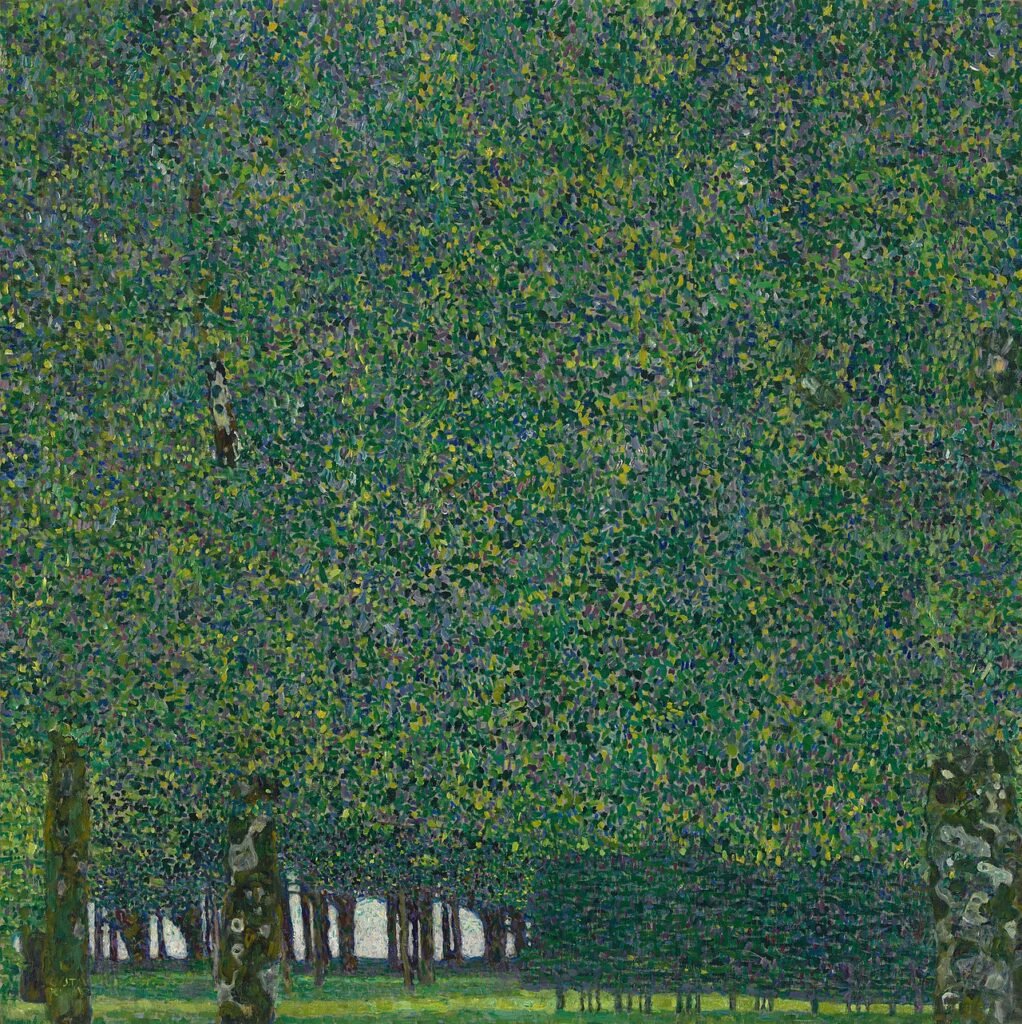
Gustav Klimt, The Park, 1910–1911. Oil on canvas. Museum of Modern Art, New York.
Gustav Klimt’s The Park, painted between 1910 and 1911, belongs to the quieter side of his late work: not the gold, bodies, and theatrical eroticism of the portraits, but a dense square of landscape pushed almost to abstraction. The painting is oil on canvas, now in the collection of the Museum of Modern Art in New York, and shows Klimt treating nature less as scenery than as surface: foliage, trunks, flowers, and shadow pressed into a patterned field.
What makes the painting feel modern is its refusal of a clear path into the picture. There is no dramatic sky, no figure, no picturesque opening. The park becomes an all-over composition, closer to tapestry than view, with depth nearly flattened by the repetition of green, blue, and black marks. It is still a landscape, but one already thinking like decoration, like painting, and like a curtain pulled across the world.
In that sense, The Park sits between Klimt’s ornamental Vienna and the coming language of abstraction. It keeps the intimacy of looking at trees while stripping away almost everything anecdotal. One is left with atmosphere, density, and the strange private luxury of leaves.
 Art History
4 JUNE MMXXVI. COPYRIGHT EDITRA AND THE AUTHORS.
SHARE, LIKE, DISLIKE,
SAVE NOTE
 Fashion Desk
 Notes Quotes

 Capote Alphabet
 Design Objects
 Art Desk
 John White


 Deep Cuts
 Lists
Lists
 Interiors