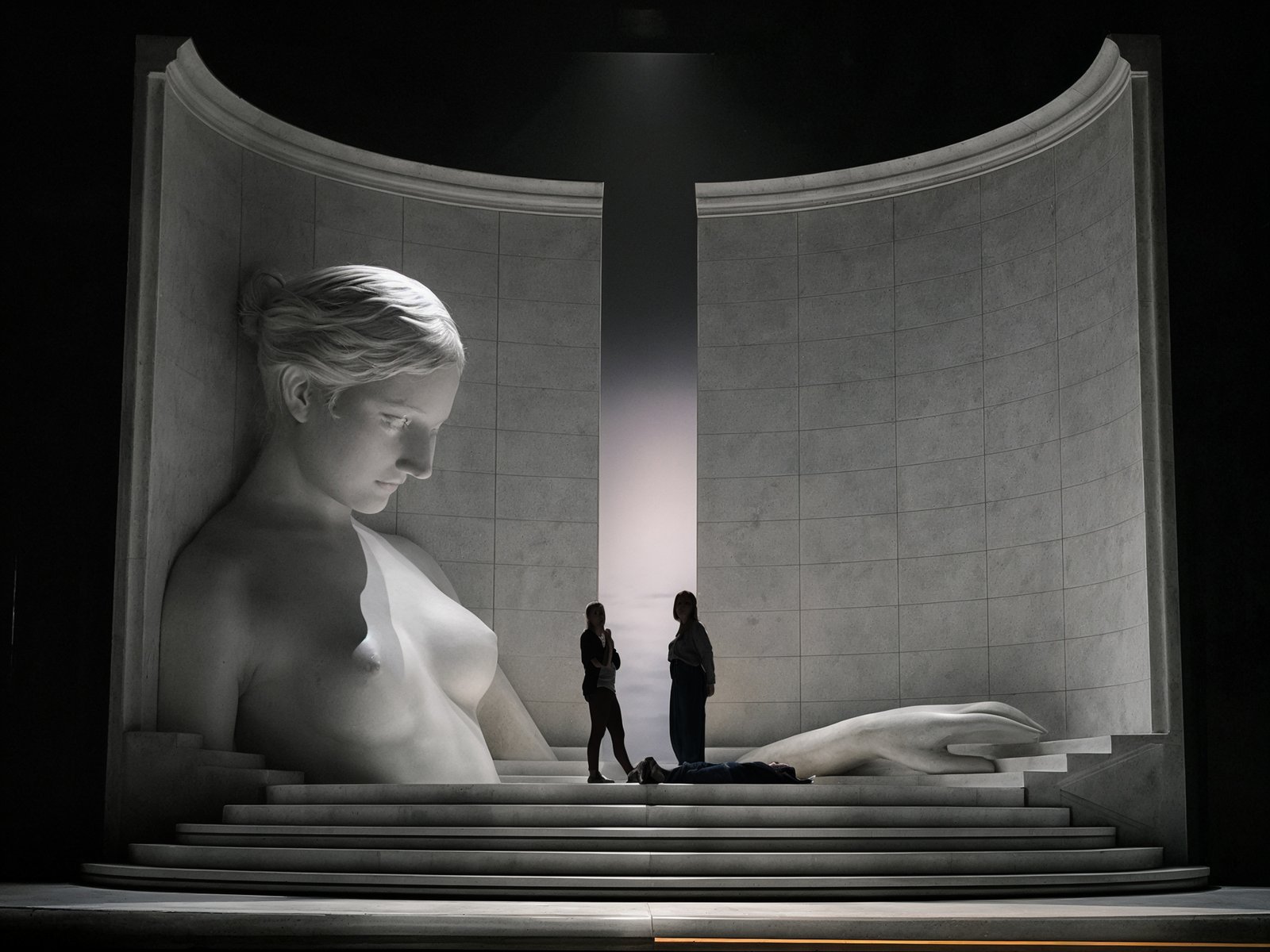
 Madina Tulakova
 Leslie Travers
How does a theatre production come to life? We often think of sound, performance, and the play itself, but what about the stage it’s set on? We sat down with Leslie Travers, an award-winning stage designer whose credits include Manon Lescaut at La Scala, Salome at Santa Fe Opera, and Death of a Salesman at the Manchester Royal Exchange, for a conversation about where the design process begins, the art of letting go of creative ideas, and the beauty of cultural differences.
MADINA TULAKOVA: Going back to the beginning, or maybe even now, what was the play or production that you saw that really made you understand the power of stage design?
LESLIE TRAVERS: There is a very specific production which fits that perfectly. I grew up in the northeast of England, in a small seaside town called Hartlepool, which had no theatre whatsoever. But it felt so distant to...
How does a theatre production come to life? We often think of sound, performance, and the play itself, but what about the stage it’s set on? We sat down with Leslie Travers, an award-winning stage designer whose credits include Manon Lescaut at La Scala, Salome at Santa Fe Opera, and Death of a Salesman at the Manchester Royal Exchange, for a conversation about where the design process begins, the art of letting go of creative ideas, and the beauty of cultural differences.
MADINA TULAKOVA: Going back to the beginning, or maybe even now, what was the play or production that you saw that really made you understand the power of stage design?
LESLIE TRAVERS: There is a very specific production which fits that perfectly. I grew up in the northeast of England, in a small seaside town called Hartlepool, which had no theatre whatsoever. But it felt so distant to the environment, the place that I grew up in.
The Royal Shakespeare Company used to tour, and I was taken by a teacher to see a production of A Man’s a Man by Brecht, done by the RSC in a school sports hall in Gateshead. It was a traverse production. So there was a strip of stage that ran from one end of the sports hall to the other, and there were two banks of seating facing each other. I had never seen anything like it.
They didn’t hide the environment it was in. It was connected to this 1960s piece of functional architecture, and I was just mesmerized by it because with a very simple staging approach, incredible actors, direction, storytelling, placement of people in that space, and the close proximity of the performers, it was just absolutely magnetic.
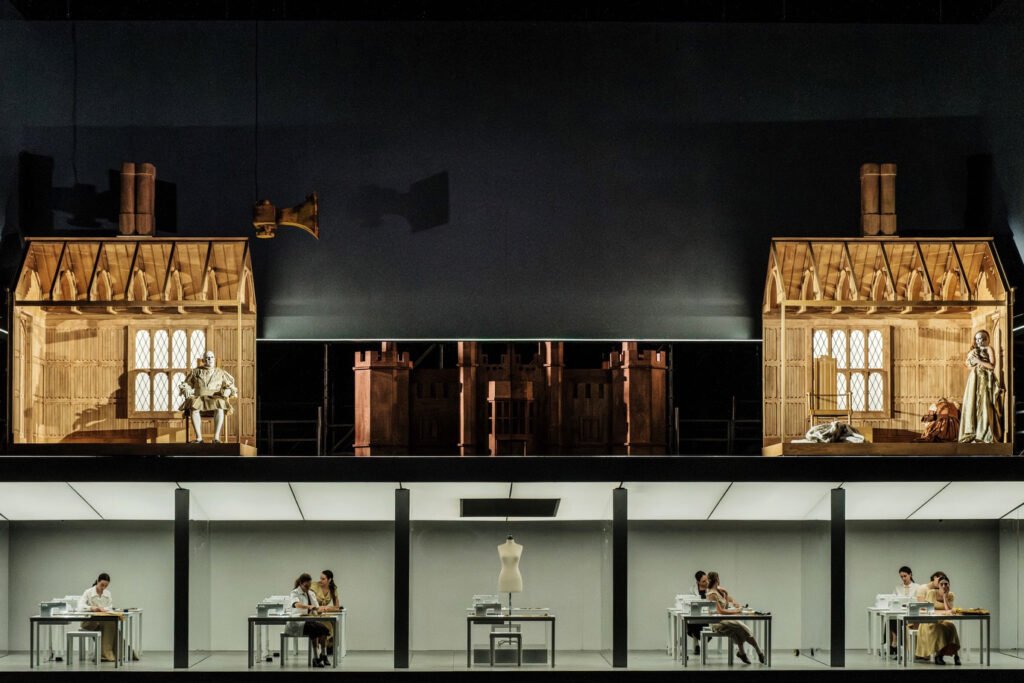
TULAKOVA: And for you specifically, where does the process start? Let’s say you get commissioned to do a stage set design. Do you go in first looking at the play, the culture that you’re going into, or the venue that it will be in?
TRAVERS: At the beginning of creating a piece, there has to be an air of discovery and excitement. Usually when I choose to do something, it’s because I feel the piece has landed at the right time in my creative life.
Where is it going to be? What is the play about? Who am I going to collaborate with? The director, and how that’s going to spin and change my process and influence the way I work. I don’t sit and close my mind and start with the script.
I’m doing a production of The Tempest for Japan now. The idea of doing a production that’s set on an island, with the atmosphere of Japan, which is somewhere where I’ve worked many times and I love dearly, is just so exciting. I’m working with Simon Godwin, the director, and we allow our understanding of that culture to come within our approach to the piece.
At the beginning it’s almost like a cathedral of sound, noise and images. Then there’s an appropriate time where I have to sit down and draw. So it’s a little bit of alchemy, really.
The ultimate effect is to allow the audience to really engage with the work fresh, especially if I’m doing a piece that’s been done so many times, like The Tempest. I feel we have to forget any other way of producing a piece and find a new way for ourselves that feels really modern, exciting, and challenging.
Some directors want to work with me really intensely in the studio and work through every detail. Others come with broad, philosophical questions, rather than direct requests, and I love working like that too.
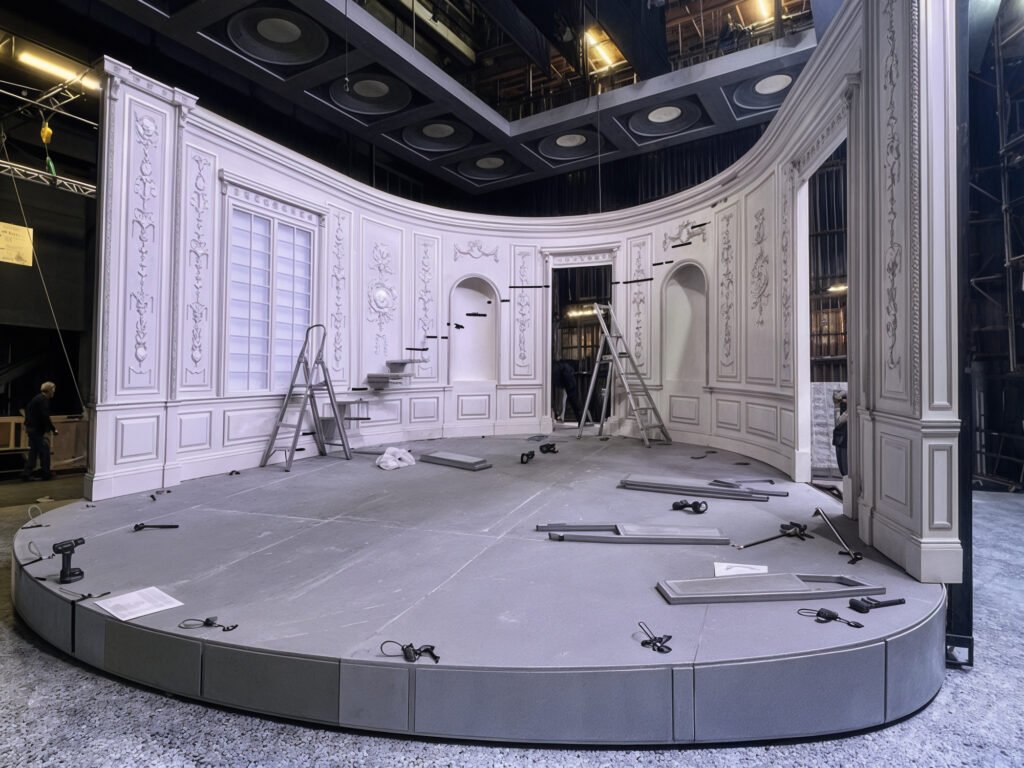
TULAKOVA: There are so many external factors that you can’t control when it comes to the venue, maybe creative differences, and sometimes perhaps you have such a strong idea that just can’t come to fruition. So spiritually, how do you let it go?
TRAVERS: That’s a really good question. Quite often an idea will feel like such a valid immediate response. I’m a great believer in instinct, where I cannot hold the idea down and this has to be expressed. But then I always have a process where I’ll illustrate those ideas, we’ll create it in the model box, and then I have a natural instinct to question it and critique it, and almost try and destroy the idea and see how it stands up.
Sometimes I have to throw ideas out, and it’s painful. That is a necessary part of the process. Twenty-four hours later, I’m over it, I’m fine, and it’s a new day.
I have to be careful that my studio isn’t a graveyard of ideas that didn’t quite make it through into a developed design. So I’m pretty rough on my work. I challenge it all the time.
I’m often working in places where the theatre itself is a box of tricks. It is a machine. Budget’s another one, that’s a big element of it, that it has to be something the company can afford.
Even with the most difficult demands, you can always make a better show. That’s the joy.
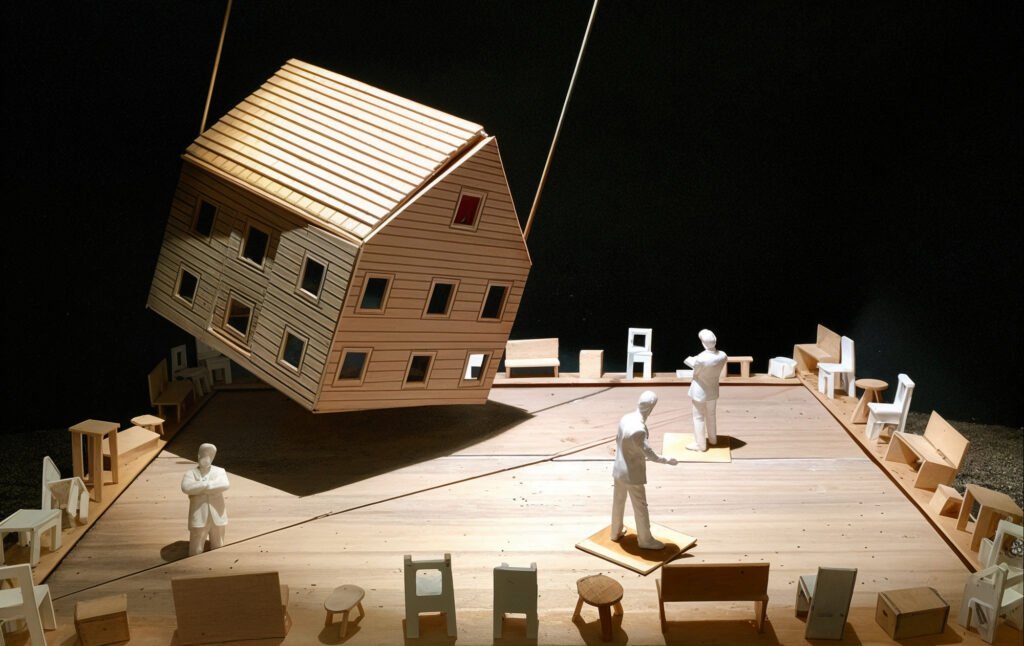
TULAKOVA: To touch on culture, because you’ve worked with so many different ones, you have the Americas, Europeans, Asians, do you go into a production with a culture in mind? Or do you go in with your heart fully open and see what works?
TRAVERS: I go in with my heart fully open. Quite often I’m asked to do things because of what I can bring, which is really exciting, and there’s such a thrill in the fact that I’ve just worked with a company in Shanghai. I recognize that there are designers everywhere, and there are designers in the country that I’ve got to work in who could have been asked—they’re asking me to bring my own take to it. So I have to respect that.
I do have to be respectful of cultural differences. We don’t sacrifice what the piece is about, but we don’t step on a cultural request. I’ve never really had any problems with my approach being viewed in any particular way.
It’s just really exciting for me to take a production and create it and just to see how people in different cultures respond to the work. Japan’s amazing, because people really watch, and then they go away and think about it, and they deconstruct the work.
Quite often I realize there are fewer differences and there is more commonality, perhaps because we work in the theatre community, and the structure in some way is always the same.
Most of my friends are people I’ve met on my travels who I’ve worked with closely, because it’s a very powerful, intimate relationship. We’re making something that’s so much about the human experience.
TULAKOVA: How does that, not to get too sensitive, not hurt you? Maybe you go to Japan and you’re fully open to those ideas, and then let’s say next month you have to go to Ireland. How do you detach from that world and immerse yourself into the next one?
TRAVERS: It’s really difficult. We can finish work in Tokyo, then fly to Canada, and suddenly it’s completely different. That detachment is really hard, because you spend such an intense period working somewhere, and you feel like a family. And then suddenly the production opens, and then you have to leave.
I miss Shanghai terribly. But the reality of what I do is that it has to. My time somewhere is finite, and then I have to jump into something else, and do it all again.
But the other side of that is, with that enormous sensitivity, there is a difficulty, because sometimes it hurts to leave a situation—and with that there is a kind of sadness after it’s over. But I’d rather be sensitive and open and myself than have it feel like just a job.
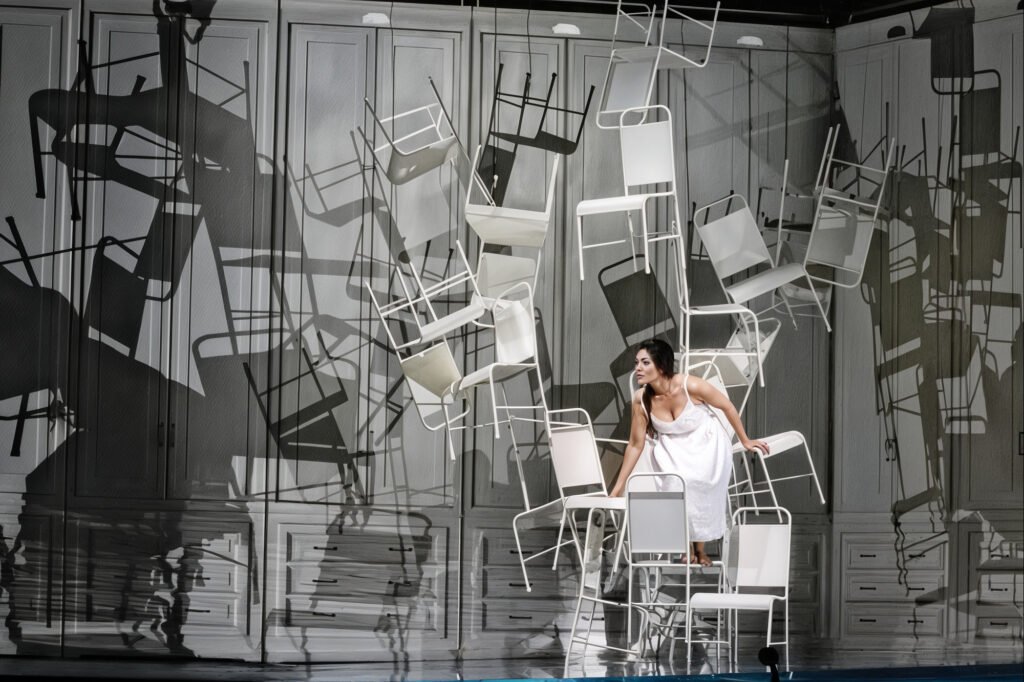
TULAKOVA: I wanted to touch on the digital and social aspects. A lot of people, especially in the culture of Instagram, find their way to the arts through their phone screens. So how do you fight that, or do you ever have the urge to think, “Oh, this is going to do so well on social,” and does this maybe conflict with the stage design?
TRAVERS: It’s really interesting, because I am an avid user of Instagram. I think one of the reasons I do that is because a work is so ephemeral and short-lived—a production happens somewhere far away, and then it disappears. So it’s a way of recording that moment and holding that moment.
I’m known for doing work that’s quite kinetic, and evolving. I don’t do scene changes, I don’t do the moment where suddenly the piece has to stop and then something has to happen, then it can restart.
It’s a useful thing for me, because I’ve had people approach me about work who probably wouldn’t have known about me. My desire is always to be someone new when I work with them.
I like to record the process, not just the finished thing. I almost use Instagram like a public diary.
TULAKOVA: Do you ever see productions where excessive use of technology feels almost gimmicky, and kind of takes away from the human experience?
TRAVERS: I think it’s key not to over-illustrate the story. And I find it really difficult when the design, and especially video, over-illustrates that. I think design is not about real space, it’s emotional architecture.
The productions I really love are the ones where I can’t stop thinking about them, because they’ve opened my mind and allowed me to contribute. So the danger with technology is that we overwork the space and we overwork the story, and then push out the audience.
And the problem with technology is it falls within that, and then we don’t create a space that’s detached from that, where we are all collectively watching something. So I feel that’s what’s brilliant about performance.
Technology is great, but it should be used in the same way that we select materials—it fits within that, tightly, seamlessly within the design, and it’s not fighting with different elements.
We should never say we’re going to use video, or we’re going to use this, because suddenly you start immediately thinking of that in the process. We absorb it and use it in the right way, at the right time.
Member Access
Free
Join New York-based Editra.
 Pina Lomb
 Marguerite de Ponty
 Art History